
Security Notice: This scam layout was detected, analyzed, and contained firsthand by the
Antiphishing.bizsecurity team during our daily link moderation procedures. To protect the public, the dangerous destination URL has been safely deactivated within our infrastructure. We document and analyze these live visual patterns to help security researchers and users detect replica fraud techniques before financial damage occurs.
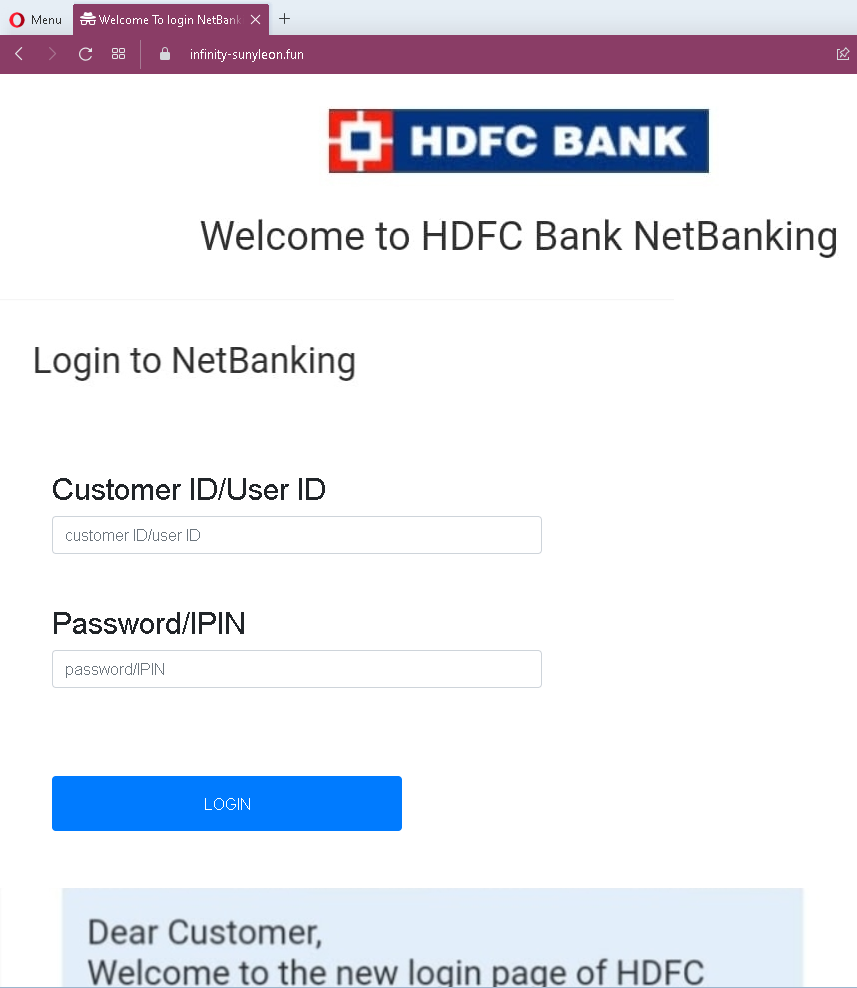
Threat Analysis: HDFC Bank Phishing – Fake NetBanking Login Page
This phishing campaign impersonates HDFC Bank, a major Indian financial institution. The page mimics the bank’s NetBanking login interface to steal customers’ Customer ID/User ID and Password/IPIN (Internet Personal Identification Number).
How it works:
The victim receives a phishing email, SMS, or other message claiming a security alert, account issue, or the need to verify their information. The message includes a link to this fake HDFC Bank login page. When the victim enters their Customer ID/User ID and Password/IPIN and clicks “LOGIN,” the credentials are captured and sent to the attacker.
The goal:
The attacker aims to steal the victim’s HDFC Bank online banking credentials. With these, they can log into the victim’s real bank account, view balances, transfer funds, and commit fraud.
Red flags to watch for:
- Suspicious URL: The page is hosted on a domain that is not
hdfcbank.com - Unsolicited login request: HDFC Bank does not send emails or messages with links requiring customers to log in to resolve account issues. Customers should always access NetBanking by typing the official URL directly or using the official mobile app.
- Minimal design: While the page includes the HDFC Bank logo and a simple form, it lacks the full navigation, security notices, and personalized elements present on the legitimate NetBanking portal.
- Missing security features: Legitimate HDFC NetBanking pages typically include additional security elements such as a virtual keyboard, security image, or multi-factor authentication steps. This page has only a basic form.
- Generic welcome message: The page includes a generic “Dear Customer” greeting, which is common in phishing pages. Legitimate HDFC NetBanking pages often display a personalized welcome message or security phrase after initial identification.
- No account recovery options: The page lacks links for forgotten Customer ID or Password that would be present on the real login page.
What to do if you encounter this:
- Do not enter your Customer ID, Password/IPIN, or any other personal information on this page.
- If you are an HDFC Bank customer, always access NetBanking by typing
hdfcbank.com - If you have already entered your credentials, contact HDFC Bank immediately through their official customer service hotline to secure your account and change your password.
- Report the phishing page to HDFC Bank’s fraud department (e.g., by forwarding the original message to
[email protected]or using their official reporting channels).
Why this scam is effective:
HDFC Bank has tens of millions of NetBanking users in India. The page uses the bank’s logo and a clean, simple design that resembles the real login screen. The request for “Customer ID/User ID” and “Password/IPIN” matches the terminology used by the bank. Many customers are accustomed to logging in through various portals and may not immediately notice that the URL is incorrect.
Protective measures:
- Bookmark the official HDFC NetBanking login page and use that bookmark to access online banking—never click links in emails or messages.
- Use a password manager: It will autofill only on legitimate
hdfcbank.com - Enable two-factor authentication (2FA) on your HDFC Bank account if available, to add an extra layer of protection.
- Be suspicious of any unsolicited message that creates urgency and asks you to log in to your bank account.
- Check the URL carefully: Legitimate HDFC Bank domains end with
hdfcbank.com - If in doubt, contact HDFC Bank directly using a phone number from your bank statement or the official website—never use contact information provided in a suspicious message.