
You Are Not Paranoid — You Are Being Hunted: The Hidden Trap That Connects a Fake Wallet to Your Life Savings
A Toronto tech professional, a newlywed from Hyderabad, and a retired Malaysian civil servant. Different cities, different lives, different ambitions. All of them had one thing in common: they believed a digital investment platform could change their future. All of them were wrong. The platform was a ghost — a set of polished web pages, fake profit dashboards, and malicious smart contracts designed to do one thing: drain every asset in their connected wallets.
This is not a story about isolated fraud. It is a map of a global, cross‑border phishing network that uses fake “staking” portals, look‑alike decentralised finance (DeFi) sites, and paid social‑media campaigns to harvest seed phrases and wallet permissions from people who, like you, are simply trying to grow their money.
This guide is for everyone who holds cryptocurrency, trades on decentralised exchanges, or has ever been tempted by a “high‑yield” crypto offer. Whether you are a retail investor in Singapore, a freelancer in Germany, or a retiree in South Korea, the tactics described below are aimed squarely at your trust, your speed, and your hope. Understanding them — and adopting three simple, non‑negotiable rules — is the only thing that will keep your digital assets safe.
The Anatomy of the Trap: How the Intercontinental Scam Turns Your Wallet Into a Criminal’s Playground
The scheme uncovered by the Antiphishing.biz security team is not a crude email from a stranger. It is a professional, scalable criminal enterprise that combines cutting‑edge ad technology, fake platform design, and old‑fashioned psychological pressure.
Step One: The Ad That Finds You Where You Are Relaxed
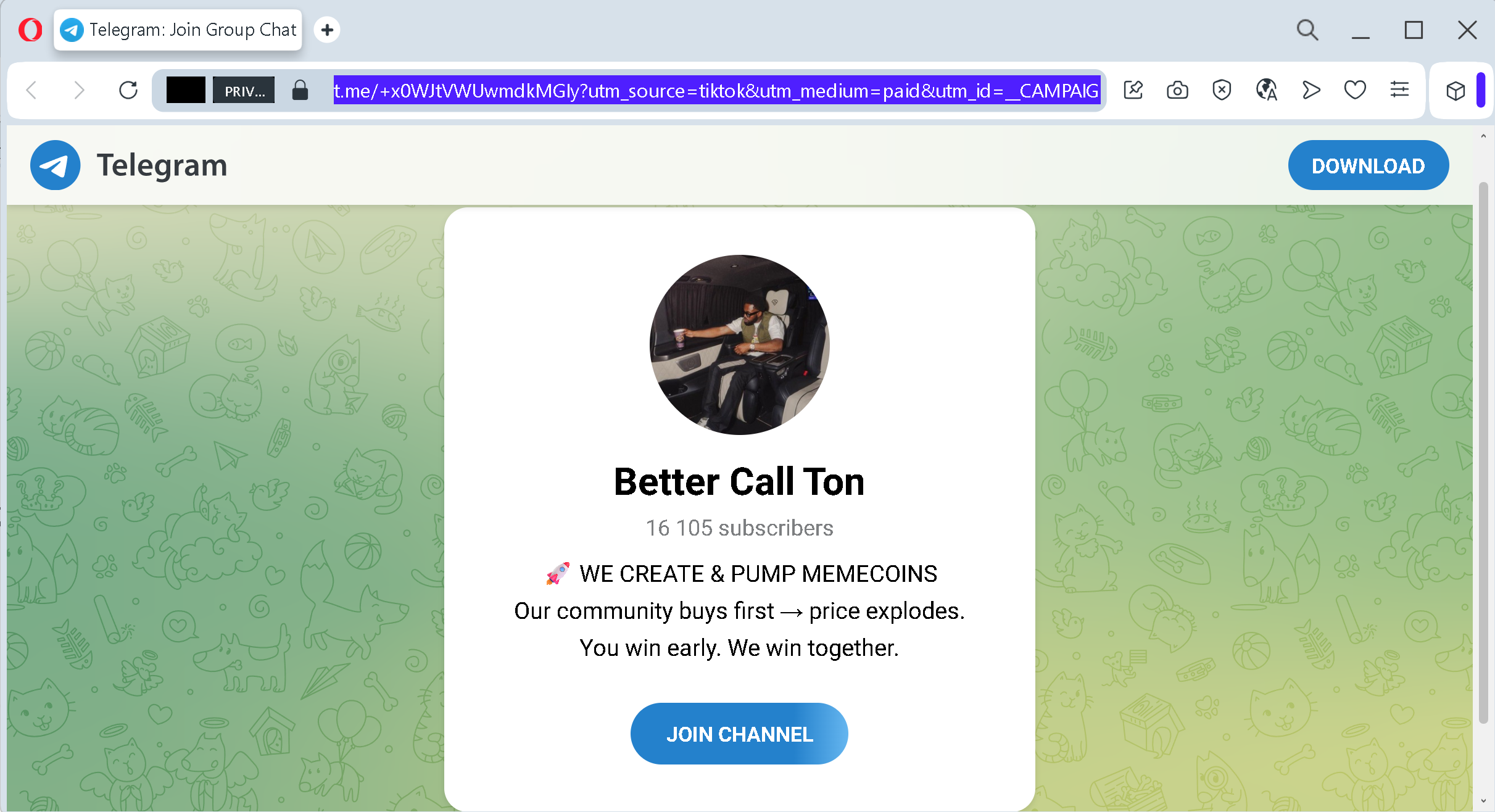
The attack begins on social media, not in a spam folder. In the case study documented by the Antiphishing.biz team, the criminals ran paid advertisements on TikTok. They targeted an affluent region — Singapore — where many people are curious about cryptocurrency but not deeply technical. The ads carried professional tracking parameters (utm_source=tiktokutm_medium=paid
The ads promised “get‑rich‑quick” opportunities, often involving TON‑based memecoins. The traffic was funnelled to a private Telegram channel called “Better Call Ton”, where organisers manipulated markets and enticed users to “connect their wallets” to a phantom portal. The infrastructure behind the campaign was traced to Morocco (IP cluster 154.144.253.x) — a geographic mismatch that any security engine would flag, but a casual scroller would never notice.
Threat Intel: This scam layout was intercepted, verified, and locked down firsthand by the
Antiphishing.bizsecurity team during our automated link scanning workflows. To protect the public, the hostile origin link has been safely deactivated within our infrastructure. We document and analyze these live visual patterns to help security researchers and users spot lookalike phishing methods before financial damage occurs.
Step Two: The Fake Platform That Does Nothing Except Steal
Once a victim clicks the ad and follows the Telegram link, they are directed to a website that looks exactly like a legitimate DeFi platform. The interface is polished. It shows attractive “staking” returns, copy‑traded portfolios, or exclusive “pre‑mine” opportunities. The criminals have invested time in making the page feel real.
But the page has only one genuine function: to prompt the user to “connect” their crypto wallet (MetaMask, Trust Wallet, etc.) or to “verify” their account by entering a seed phrase (the 12‑ or 24‑word recovery phrase). In the case analysed by security researchers, the platform was not a trading engine; it was a malicious front designed to capture credentials or trick users into signing a permission transaction.
Step Three: The Malicious Smart Contract That Drains Everything
When you click “Approve” or “Connect” on a fake platform, you are often signing a smart contract — a piece of code that runs on the blockchain. Legitimate DeFi apps use such approvals to allow a protocol to move your funds only for a specific transaction. But here is the trap: many scam contracts request “unlimited approval” for a specific token (e.g., USDT). The technical term for this is “ERC‑20 approve” — it grants a third party permission to transfer your tokens as they wish.
The scammers deploy a malicious contract that looks harmless. You sign what you think is a “login” or “staking” transaction. In reality, you have handed the attacker a blank cheque. They can now call an on‑chain function to transfer any amount of that token from your wallet at any time — without further approval from you. They often wait days or weeks, watching balances grow, before executing a single massive drain.
Alternatively, if the fake site asks for your seed phrase directly, the theft is instant. The attacker enters your phrase into a fresh copy of the wallet application and transfers every asset in every account derived from that phrase. There is no recovery. Your money is gone.
The Human Cost of Crypto Fraud: Stories From Four Continents
These are not abstract warnings. They are the accounts of real people who lost money they had worked for years to accumulate — and in at least one case, lost the will to go on.
A Toronto Tech Professional Who Lost Over $42,000 to a Look‑Alike Staking Site
A technology professional in Toronto, Canada, saw an advertisement for a new “liquid staking” platform. The returns were higher than any legitimate protocol offered, but the website looked professional and the project had a detailed whitepaper. He connected his wallet and clicked “Approve” to deposit a small test amount. The test worked; he saw a confirmation on the blockchain. Believing the platform was legitimate, he deposited his main holding — more than $42,000 in stablecoins and Ethereum. Within 48 hours, every token in that wallet was transferred to an address that the blockchain analytics firm Scam Sniffer had labelled as high‑risk. The platform’s website disappeared. The Telegram channel was deleted. The professional told investigators: “I’m not a beginner. I checked the contract address on Etherscan. It looked normal. I did not know that ‘unlimited approval’ was a button I should never click.”
The Hyderabad Techie Who Borrowed ₹1.04 Crore and Then Paid for it Catastrophic Human Cost
A 35‑year‑old IT employee in Hyderabad, India, met a woman named “Sunita Bharggavasa” on a matrimonial website. She claimed to live in London. After weeks of chatting, she persuaded him to invest in bitcoin through a website she recommended. The platform showed small, convincing profits — around ₹14,000 on his first ₹1.1 lakh deposit. Encouraged, he invested more: ₹5 lakh, ₹10 lakh, ₹20 lakh. When his virtual balance showed over 200,000 USDT (approximately ₹1.7 crore), he tried to withdraw. The platform demanded a 10% tax, then a “money laundering” fee, then a transfer fee, then more fees. He borrowed from banks, friends, and credit cards, eventually sending a total of ₹1.04 crore. On December 20, 2025, after the platform still refused to release his money, the overwhelming financial loss led to a sudden and heartbreaking family tragedy at his home in Gajularamaram. Police records show that the app later displayed a virtual profit of ₹1.5 crore and demanded an additional ₹79.5 lakh to process a withdrawal. The trading platform was forged from the start.
The Shelton, Connecticut, Man Who Lost His Retirement Portfolio
Joe Allen, a former physical therapist from Shelton, Connecticut, received a text message in August 2025 from a company calling itself “ZAP Solutions”. It offered a work‑from‑home crypto investment opportunity. Joe wired $30,000 with a promised return of $368,000. When the return did not materialise, he was asked for more money. And more. When he was locked out of his account, the scammers demanded even more to restore access. By the time Joe stopped, he had lost $228,000 — his entire 401(k), his IRA, his investment accounts from his divorce. “Every penny I own has been wired away,” he told WFSB. His mother, Carol, said police told the family there was no hope of recovery: “People get taken when they’re at their lowest, and they think there’s an opportunity out there”.
A Retired Malaysian Civil Servant Who Lost RM525,000
A 71‑year‑old former government director in Kuala Terengganu, Malaysia, saw a cryptocurrency investment advertisement on Facebook on 23 May 2025. The ad promised returns of USD 500,000. He communicated with the syndicate online and, between 20 and 27 August, made seven bank transfers using his own pension savings. The total loss was RM525,000 (over $110,000 USD). Kuala Terengganu Police Chief ACP Azli Mohd Noor confirmed that the syndicate was non‑existent — a pure phantom. The victim had wired his retirement money to a ghost.
The People Who Saw the Trap Before It Closed
Not everyone loses everything. Some people, through a combination of caution and small but critical actions, recognised the fraud before they clicked “Approve”. Their examples are not just inspiring; they are instructional.
The Investor Who Checked His Existing Approvals and Saved a Six‑Figure Balance
A relatively experienced crypto user in Germany received a “wallet connection” request from what appeared to be a new decentralised exchange. Before clicking the “Approve” button, he opened a separate tab and navigated to Revoke.cash, a free tool that lists all active token permissions granted to third‑party contracts. He saw an old, unused approval for a DeFi protocol he had not interacted with in two years. It was still set to “unlimited”. Instead of proceeding with the new site, he revoked that old permission and then manually checked the contract address of the new platform against a reputable blockchain explorer. The contract had been deployed only three days earlier and had no verified source code. He closed the page and reported the domain. That 15‑minute check saved him approximately $180,000 in crypto assets.
The Woman Who Asked, “Why Does a Staking Site Need My Seed Phrase?”
A Singapore‑based investor was invited to a “premium staking pool” via a Telegram message. The website looked professional, but at the final step, it asked for her wallet’s 12‑word seed phrase to “verify her account”. She had read a security warning just days earlier: “No legitimate support team, exchange, or platform will ever ask for your 12‑ or 24‑word recovery phrase.” She refused, blocked the Telegram contact, and posted a screenshot in a local crypto forum. Within hours, three other members confirmed they had received the same message. Her refusal to violate the golden rule protected her entire portfolio.
Expert Advice: Three Non‑Negotiable Rules to Protect Your Digital Assets
The following rules are not optional. They are the difference between staying safe and becoming another statistic.
1. Never, Ever Share Your Seed Phrase. Not With “Support”. Not With a “Platform”. Not With Anyone.
Your 12‑ or 24‑word recovery phrase is the key to your entire wallet. Anyone who holds it can regenerate your wallet and transfer every asset without needing your password, your phone, or any additional approval. No legitimate support team, exchange, or decentralised application will ever ask for your seed phrase. Not by email. Not by chat. Not in a pop‑up window. If any platform requests it — even for “verification”, “wallet sync” or “recovery purposes” — that platform is a scam. Type your seed phrase only into the original wallet software on a device you fully control, and only when recovering a wallet you already own.
2. Audit Smart Contract Permissions Before — and After — Every Interaction
When a decentralised application asks you to “Approve” a token transfer, you are granting a contract permission to move your funds. Many malicious approvals request unlimited access (2^256 - 1
- Use a blockchain explorer (such as Etherscan for Ethereum) to verify the contract address. Does it match the address published on the project’s official, verified social‑media accounts? Have other users reported the contract as malicious?
- Use a permission‑audit tool such as
Revoke.cash. This tool shows you every approval you have ever granted to third‑party contracts. Revoke any permissions you no longer need, and always revoke permissions after interacting with a new or unverified protocol. - Be extremely wary of approvals that ask for “unlimited” spending. Legitimate protocols rarely need unlimited permissions for ordinary staking or swapping.
The Revoke.cash browser extension can warn you in real time before you sign a potentially harmful transaction. Install it, use it, and make revoking old permissions a weekly habit.
3. Treat Unknown Domains Ending in .top, .xyz, or .win as Hostile — And Verify Everything Manually
The criminals behind the intercontinental scam used paid advertisements on TikTok, but the landing pages were hosted on suspicious domains and infrastructure far from their claimed headquarters. Scam sites often use cheap top‑level domains (.top.xyz.win.shop.icubest-shop43.com
- Manually type the official project domain into your browser. Do not click links from social media posts, direct messages, or forwarded emails.
- If you are unsure, search for independent reviews of the platform. Look for warnings from blockchain security firms such as Scam Sniffer, SlowMist, or PeckShield.
- Check the domain’s age using a free WHOIS lookup tool. Many phishing sites are registered only days before the campaign launches.
- If the offer promises guaranteed high returns, exclusive “pre‑mine” access, or secret staking pools, it is a scam. No legitimate DeFi protocol needs to advertise via urgent Telegram messages.
What to Do If You Have Already Fallen for This Scam
If you have clicked “Approve” on a suspicious contract or entered your seed phrase into a web form, act immediately.
- First, if you still have access to your wallet, immediately transfer all remaining assets to a completely new wallet that you have generated on a clean device. Do not delay; the attacker may be waiting for a larger balance to accumulate.
- Second, use
Revoke.cashor a similar tool to revoke all approvals from the compromised address. The attacker may not have acted yet, but revoking permissions closes the door. - Third, contact your local police or national cybercrime unit. File a report with the FBI’s IC3 (if in the United States), Action Fraud (UK), or your country’s equivalent. Provide the contract address, the transaction hashes of the approvals, and any communication with the scammers.
- Fourth, warn your community. Post the scam contract address and the fake domain in crypto forums, on X (formerly Twitter), and in Discord groups. Your warning could save another user.
A Final Word
The intercontinental crypto scam described here is not a failure of blockchain technology. It is a failure of human trust — and the criminals know it. They build beautiful fake portals. They run polished ad campaigns. They hire people to run Telegram chats and provide “customer support”. They do everything except build a legitimate business.
But the scam has a fatal weakness: it relies entirely on you clicking “Approve” before you have asked the hard questions. Every story of loss in this guide could have been prevented by one of three actions: refusing to share a seed phrase, auditing a smart contract permission, or manually verifying a domain.
You are not paranoid for checking a contract address twice. You are not rude for refusing to send your seed phrase to a “support agent”. You are not slow for taking an extra ten minutes to research a platform. You are smart. And in the world of crypto, being smart is the only real protection.
The scammers are counting on your speed, your hope, and your fear of missing out. Do not give them any of those things. Stay slow. Stay sceptical. And remember: if a platform asks for your seed phrase or for unlimited approval, it does not want your investment — it wants your entire wallet.
This attack pattern was identified, verified, and neutralised by the Antiphishing.biz security team during their automated scanning workflows. The hostile origin link has been fully deactivated within their infrastructure. If you found this guide helpful, share it widely — and never, ever approve unlimited spending on a contract you do not fully understand.