
Threat Analysis: Fake Gendarmerie Nationale “Pedophilia Investigation” Sextortion Scam
This campaign impersonates the French National Gendarmerie (Gendarmerie nationale) and falsely claims the victim is under judicial investigation for serious offenses (pedophilia, cyber-pornography, etc.). The goal is to extort money, personal information, or both by creating extreme fear of arrest, imprisonment, and public exposure.
How it works:
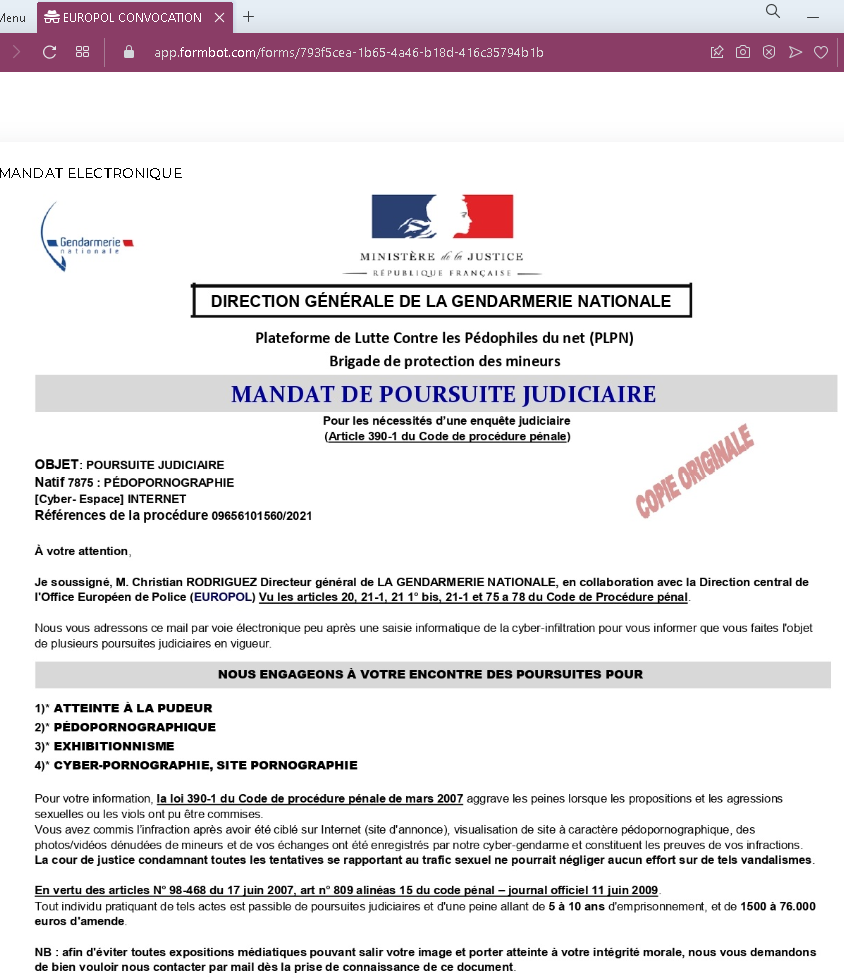
The victim receives an email containing these documents. The email and the attached pages are designed to look like official legal documents from the French Gendarmerie and Europol. The scam includes:
- A fake case number and reference to legal codes to appear authentic
- A list of fabricated charges
- A threat of 5–10 years imprisonment and fines up to €76,000
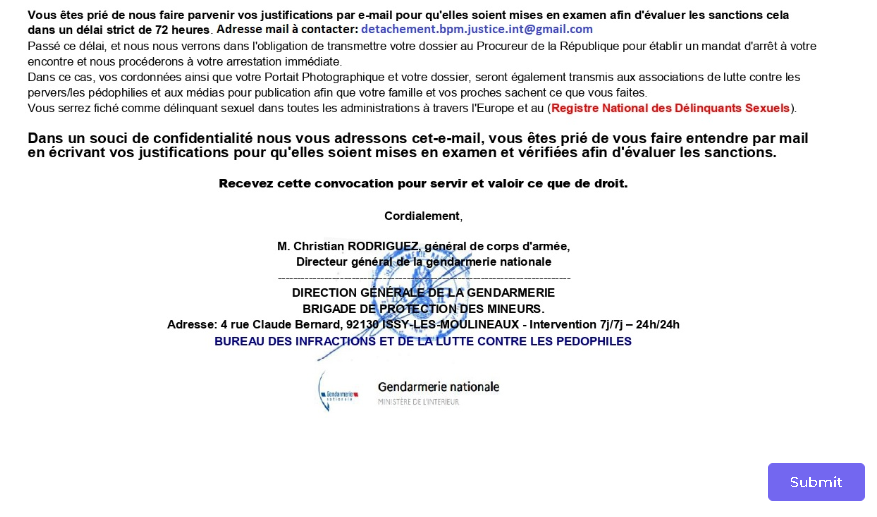
- A 72-hour deadline to respond
- A demand to send “justifications” (explanations) to a private Gmail address
- A threat to publish the victim’s information to family and media if they do not comply
The goal:
The attacker aims to:
- Extract money from the victim (by demanding payment of a “fine” or “settlement” to avoid prosecution)
- Obtain personal information (identity documents, photos, or other sensitive data) that can be used for further blackmail or identity theft
- Cause the victim to engage in a panic-driven communication that leads to further exploitation
There is no actual investigation—the entire document is fabricated.
Red flags to watch for:
- Generic email contact: The provided contact address is a free Gmail account (
[email protected]). Legitimate French law enforcement agencies use official@gendarmerie.interieur.gouv.fror similar government domains—never Gmail. - Threats of public exposure: Official legal proceedings do not threaten to publish personal information to the media or family. Such threats are a hallmark of extortion scams.
- Unprofessional formatting: The document contains inconsistent formatting, generic language, and minor stylistic errors that would not appear in official legal correspondence from a national law enforcement agency.
- 72-hour ultimatum: Artificial urgency is a classic scam tactic to prevent the victim from calm thinking and seeking legitimate advice.
- Vague legal references: While the document cites articles of French law, the way they are presented is generic and lacks the precision of a real legal summons or warrant.
- No official seal or verifiable reference number: The document lacks an official case number that could be verified with the actual Gendarmerie.
- Unsolicited contact: Legitimate law enforcement agencies do not initiate serious criminal investigations via email with demands to respond to a Gmail address.
What to do if you encounter this:
- Do not reply to the email or contact the provided Gmail address.
- Do not send any money, personal information, or “justifications.”
- Do not click any links or download any attachments from such messages.
- If you are concerned that the email might be legitimate (which it is not), contact the actual French Gendarmerie through their official website or by visiting a local police station—never use the contact details provided in the suspicious message.
- Report the scam to the official anti-fraud platform in your country (e.g., in France, use
internet-signalement.gouv.fr).
Why this scam is effective:
This type of “law enforcement” scare scam preys on fear and shame. The serious charges (pedophilia, cyber-pornography) are designed to cause extreme distress and panic. Victims may feel too embarrassed to seek help and may pay the demanded “fine” or provide personal information in an attempt to make the situation “go away.” The use of official-sounding legal language, French government references, and the Europol collaboration adds a layer of false credibility.
Protective measures:
- Legitimate law enforcement agencies never contact individuals via email with demands to respond to a private email address to avoid criminal prosecution.
- Never respond to unsolicited threats of legal action received by email, especially those demanding payment or personal information.
- If you receive such an email, do not engage. Forward it to your national anti-fraud or cybercrime reporting center and delete it.
- Be aware of sextortion scams: Scammers often use fake legal documents to frighten victims into paying money. No legitimate legal process involves threatening to “publish” your information to family and media.
- If you are genuinely concerned, contact a lawyer or visit a local police station with the email—do not use the contact details provided in the scam message.
This type of scam is particularly cruel because it exploits fear of legal consequences and public humiliation. Victims who are vulnerable or have genuine privacy concerns may be especially susceptible.