
This screenshot shows a lottery or prize scam impersonating Lowe’s, a major home improvement retailer. The message claims the victim has won a prize and includes a fake customer number. The scam typically demands a small “delivery fee” to release the prize – which is never actually delivered.
Security Notice: This scam layout was detected, analyzed, and contained firsthand by the
Antiphishing.bizsecurity team during our automated link scanning workflows. To protect the public, the phishing source domain has been fully defanged within our infrastructure. We document and analyze these live visual patterns to help security researchers and users detect replica fraud techniques before financial damage occurs.
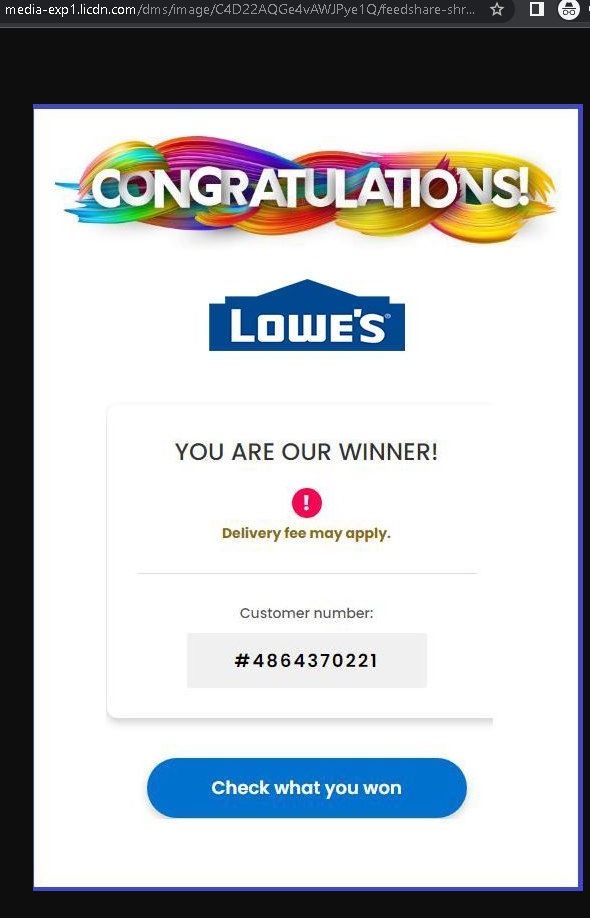
Threat Analysis: Lowe’s Prize Scam – Advance Fee Fraud
How it works:
The victim receives an unsolicited email, SMS, or social media message claiming they have won a prize (often a gift card, appliance, or cash) from Lowe’s. A “customer number” is provided to make the notification appear legitimate. The message mentions that a delivery fee may apply. If the victim responds or clicks a link, they will be asked to pay a small fee (e.g., $5–$20) to “cover shipping” or “processing” before receiving the prize. After the fee is paid, the victim never receives the promised prize – and their payment information may be stolen.
The goal:
The attacker aims to:
- Trick the victim into sending money (advance fee fraud)
- Collect credit card or bank account details if the victim pays online
- Gather personal information (name, address, phone) for identity theft or further scams
Red flags to watch for:
- Unsolicited win notification: Legitimate sweepstakes do not notify winners via random text messages or social media DMs without prior entry.
- Request for upfront payment: A real prize never requires a delivery or processing fee to be paid by the winner. The sponsor covers these costs.
- Fake customer number: The provided number (#4864370221) is generic and cannot be verified with any legitimate Lowe’s promotion.
- Vague prize description: The message does not specify what the winner has actually won – only that they are a “winner.”
- Poor formatting and grammar: Official Lowe’s communications are professionally written; this message uses generic capitalization and lacks official branding.
What to do if you encounter this:
- Do not reply, click any links, or call any phone number provided.
- Do not pay any “delivery fee” or share personal / financial information.
- If you are unsure whether a Lowe’s promotion is legitimate, contact Lowe’s directly through their official website (
lowes.com - Report the scam to the Federal Trade Commission (FTC) or your local consumer protection agency.
Why this scam is effective:
The promise of a free prize excites victims, and a small delivery fee seems reasonable. Many people are familiar with Lowe’s and trust the brand. The fake customer number adds a veneer of authenticity. Scammers rely on urgency and the fear of missing out to bypass critical thinking.
Protective measures:
- Remember: you cannot win a prize you did not enter. If you never signed up for a Lowe’s sweepstakes, ignore any win notification.
- Never pay money to receive a prize. Legitimate contests cover all costs.
- Delete unsolicited win messages without responding.
- Check the sender’s address – official Lowe’s emails come from
@lowes.com, not random domains.